Case review · Vault
Case review: fronto-temporo-parietal cranioplasty fixed with eight screws
This case, shown as a technical plate on the site, illustrates a simple rule: fix the implant on healthy bone, outside the defect. Here are its design choices, measured on the manufacturing file.
1 min read
The case
Extensive defect of the left cranial vault, in the fronto-temporo-parietal region. The aim: restore the contour of the skull and protect the brain with a Ti-6Al-4V titanium implant designed from the patient’s CT scan.
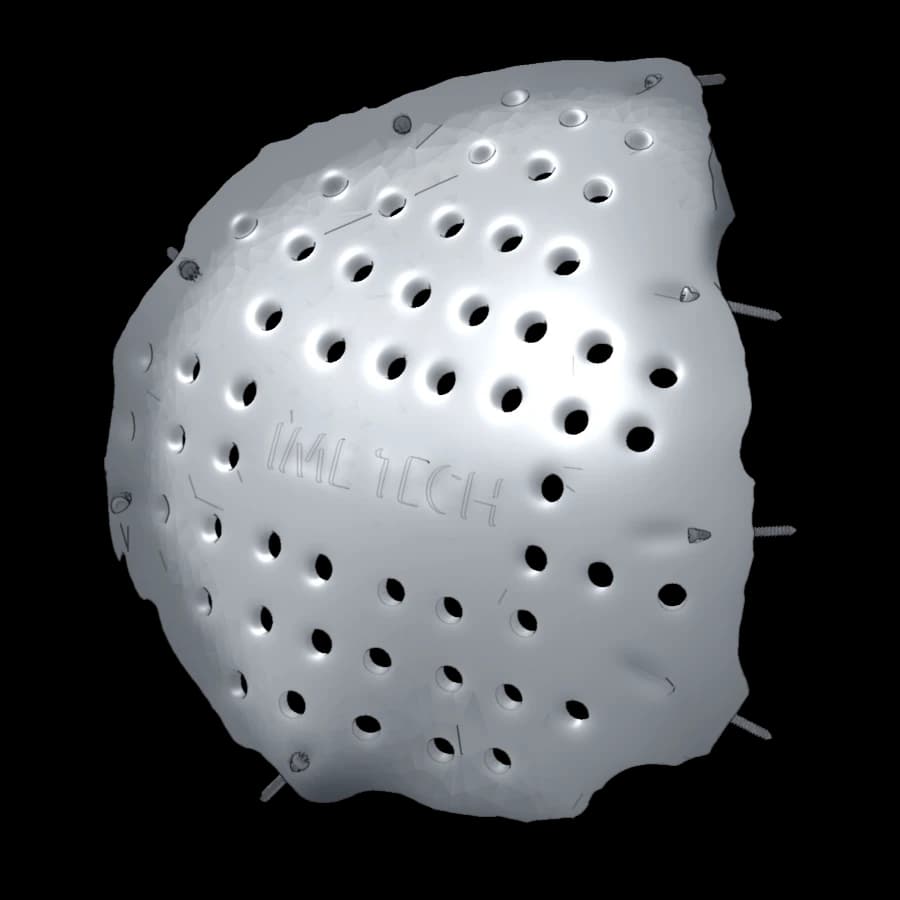 Cranial vaultLeft fronto-temporo-parietal cranioplastyLarge vault defect, peripheral fixation with 8 screws
- Overall size
- 107 × 107 × 32 mm
- Thickness
- ≈ 2.9 mm
- Volume
- 28.3 cm³
- Mass (Ti-6Al-4V)
- ≈ 125 g
The shape: mirroring the healthy side
The defect affects one side only: the healthy vault serves as the reference. Its curvature is mirrored across the midsagittal plane, then blended into the edges on the affected side. The implant rests on the bone edge all the way round.
Fixation: eight tabs outside the defect
Eight peripheral tabs each take an osteosynthesis screw 1.5 mm in diameter and 15 mm long. All sit on healthy bone, outside the defect, spread around it. The total bony support reaches about 470 mm².
The perforations
The implant has 52 perforations about 3.6 mm in diameter. They lighten the part, let fluid drain and help the covering tissue adhere. Their number and layout are set at the design stage.
What to look at in the 3D viewer
- Coronal or axial plane through a tab: path of the screw through the tab, then into the bone.
- Transparent bone: layout of the eight screws around the defect.
- Implant moved aside: shape and limits of the bone defect.
- Measurement: diameter of a perforation, distance between two screws.
General information: this article does not replace your surgeon’s advice. Prices vary with the patient, the hospital and the implant; only a formal quote is binding.
A cranioplasty case to review?
Surgeons: send the CT scan for a feasibility study. Patients: your section explains the care pathway.