Case review · Vault
Case review: bifrontal cranioplasty, when there is no symmetry to copy
A cranial implant is usually drawn as a mirror of the healthy side. When the defect crosses the midline, that model no longer exists. This case shows how the shape is then rebuilt.
1 min read1 sources
The case
Defect of the frontal region, crossing the midline. The forehead carries a large part of how a face looks: the restored contour shows, from the front as from the side.
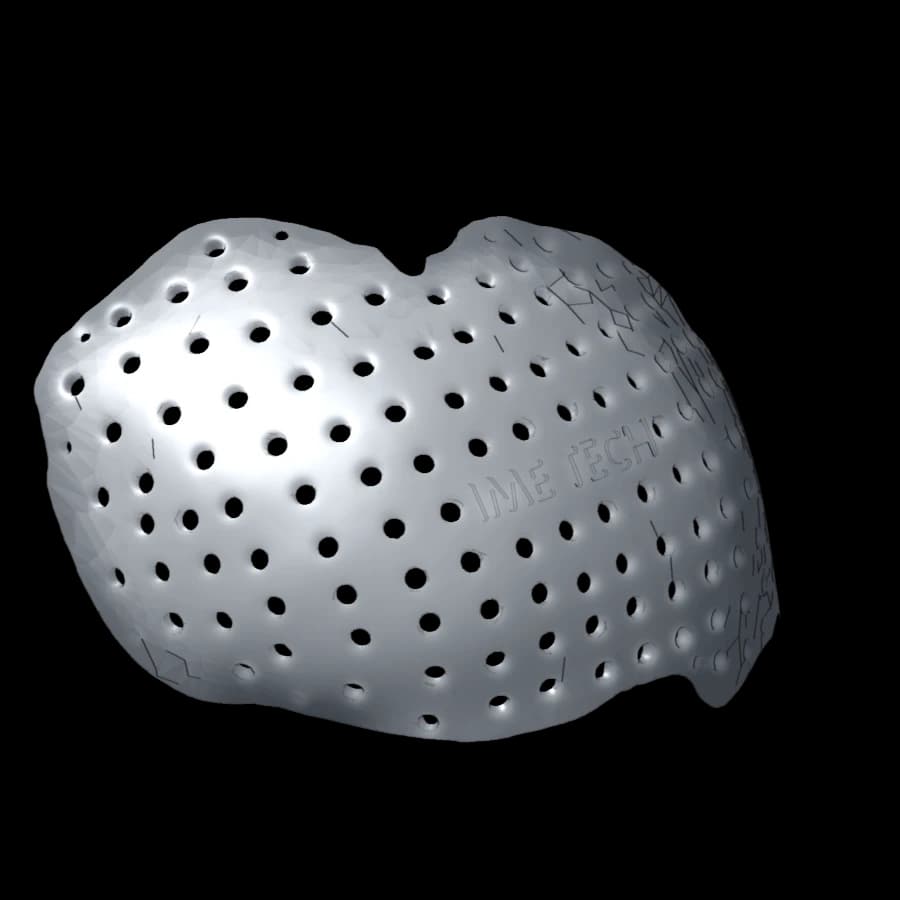 Cranial vaultBifrontal cranioplastyFrontal defect crossing the midline
- Overall size
- 130 × 102 × 88 mm
- Thickness
- ≈ 2.5 mm
- Volume
- 35.3 cm³
- Mass (Ti-6Al-4V)
- ≈ 156 g
The method: continuity of curvature
For a one-sided defect, the healthy vault is the mirror model. Here, neither side is intact. The shape is rebuilt by continuing the curvature of the healthy bone at the margins of the defect, then checked from the front and in profile to restore both forehead contours and their transition at the midline.
Why accuracy matters here
The international consensus notes that bifrontal cranioplasties are more prone to complications than one-sided reconstructions [1]. An implant that matches the edges exactly, with no step or excess thickness, spares the tissue covering the forehead.
Perforations and identification
Perforations are spread over the whole surface for lightness, drainage and tissue adhesion. The identification engraving links the part to its manufacturing record.
What to look at in the 3D viewer
- Front view: symmetry of the two forehead contours.
- Sagittal plane at the midline: restored frontal profile.
- Implant moved aside: extent of the defect on both sides.
Sources
Documents accessed in October 2026. Amounts are given in the currency and for the year of each source.
- 1Iaccarino C, Kolias A, et al. Consensus statement from the international consensus meeting on post-traumatic cranioplasty. Acta Neurochir (Wien). 2021;163(2):423-440. doi.org
General information: this article does not replace your surgeon’s advice. Prices vary with the patient, the hospital and the implant; only a formal quote is binding.
A cranioplasty case to review?
Surgeons: send the CT scan for a feasibility study. Patients: your section explains the care pathway.