Case review · Vault
Case review: a large one-piece fronto-temporo-parietal implant
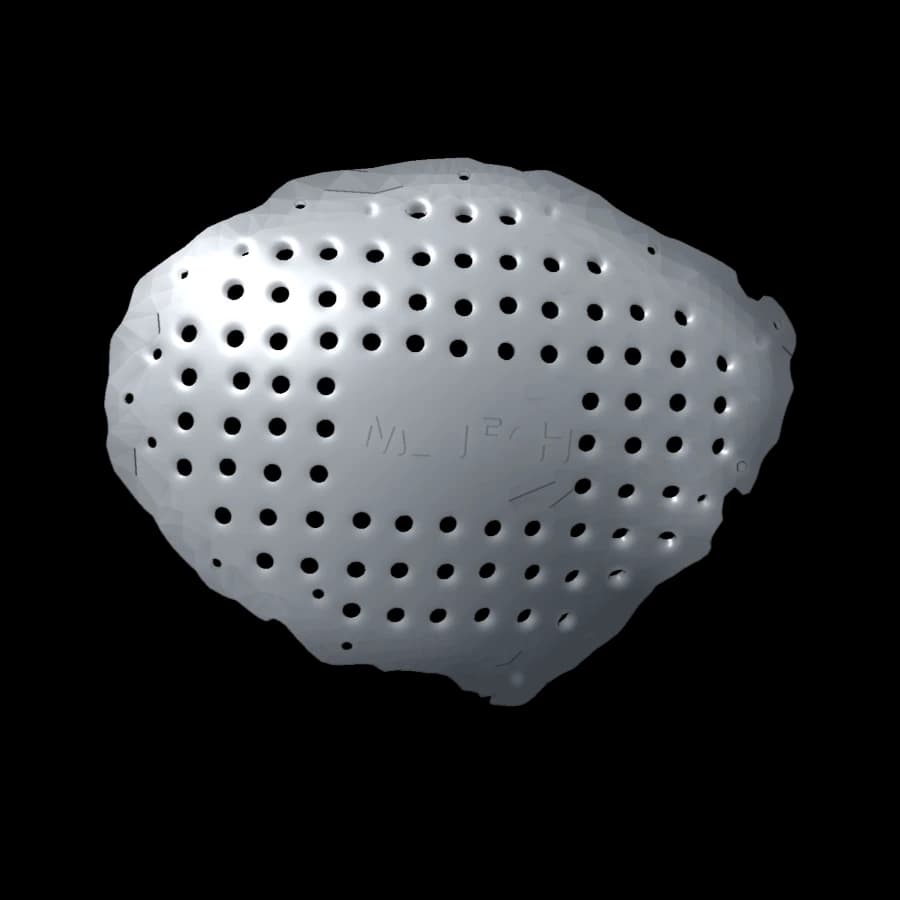
This is the implant shown in 3D on the home page of this site. It covers a large part of the vault, from the forehead to the back of the skull. Here is how its shape, perforations and fixation were designed.
1 min read
The case
Extensive lateral defect of the vault, covering the frontal, temporal and parietal regions. At this scale, the implant must be stiff, thin and perfectly fitted all the way round.
 Cranial vaultFronto-temporo-parietal cranioplastyExtensive lateral vault defect
- Overall size
- 154 × 119 × 53 mm
- Thickness
- ≈ 2.1 mm
- Volume
- 32.1 cm³
- Mass (Ti-6Al-4V)
- ≈ 142 g
One piece, one continuous curve
The implant extends the curvature of the vault to the bone edge, including the temporal region, whose contour is restored to limit visible hollowing. A single piece avoids joins between plates.
17 holes over the bone edge
The fixation holes, about 2.5 mm in diameter, are spread around the rim, just above the bone edge: each screw passes through the implant, then into healthy bone. Their diameter matches the surgeon’s screw system.
Perforations and engraving
The 69 perforations, about 3.9 mm in diameter, lighten the part and help drainage and tissue adhesion. The identification engraving on the outer surface links the implant to its manufacturing record and material batch.
What to look at in the 3D viewer
- Cutting plane through the implant: continuity of the curvature with the vault.
- Measurement: width of the overlap between the edge of the implant and the bone edge.
- Top view: transition at the midline.
General information: this article does not replace your surgeon’s advice. Prices vary with the patient, the hospital and the implant; only a formal quote is binding.
A cranioplasty case to review?
Surgeons: send the CT scan for a feasibility study. Patients: your section explains the care pathway.