Surgeons · Orbit
Custom orbital implant or preformed plate: what the studies show
Preformed plates cover most orbital fractures. Implants designed from the patient’s CT scan promise a more exact reconstruction. What do the comparative data say?
2 min read5 sources
The goal: restoring the volume and shape of the orbit
After a fracture of the orbital walls, the contents of the orbit must be put back and the cavity given back its volume, to prevent enophthalmos and double vision. The difficulty lies at the back: the floor rises towards the apex along a curve the implant must follow, far from the surgeon’s direct view.
Preformed plates reproduce an average anatomy. Custom implants are designed from the CT scan, usually by mirroring the healthy orbit, and made before surgery.
Accuracy: a consistent advantage for custom implants
| Study | Comparison | Main result |
|---|---|---|
| Prospective multicentre, 2010–2014 [1] | 100 preformed implants, 95 individualised | Significantly more precise reconstruction with individualised implants, as with navigation |
| Retrospective, 2012–2022 [2] | 45 preformed implants, 30 custom | Malposition: 66.6% vs 10%; revision after surgery: 13% vs none |
| Randomised trial, 2025 [3] | Prebent mesh versus custom implant | Volume difference from the healthy orbit: 1.67 cm³ vs 0.65 cm³ |
| Meta-analysis of 11 studies [4] | 326 conventional patients, 302 custom | Volume difference: 0.95 ml vs 0.32 ml; no significant difference in key outcomes |
In the multicentre study, intraoperative navigation also improved accuracy. Since the two were often combined, the gain is hard to attribute to a single factor [1].
In the 75-case series, preformed implants also had to be repositioned more often during surgery, after checking with intraoperative 3D imaging: 26.6% against 11% [2].
Clinical outcomes: a trend, not yet proof
The 2023 meta-analysis, covering 628 adults, notes a trend in favour of custom implants: postoperative enophthalmos in 11.2% of patients against 19.2%, and shorter operating time in 3 of the 6 studies reporting it. But no statistically significant difference appears in key outcomes, and the authors leave the choice of implant to the surgeon [4].
When to choose a custom implant?
On these data, custom implants add most when accuracy is hard to achieve otherwise:
- extensive or multi-wall fractures, especially when posterior bony support is missing;
- secondary reconstruction of enophthalmos or of a malpositioned implant;
- injuries combining the orbit with the zygoma or the rim, which a single implant can rebuild;
- fixation that must be moved away from the orbital contents, with planned screw trajectories.
For a moderate isolated fracture treated promptly, a well-positioned preformed plate, with navigation if needed, remains a validated solution [1,4]. A custom implant requires design time, to be reconciled with the two-week window recommended for repairing symptomatic fractures [5].
On the design side
A custom orbital implant is designed from a thin-slice CT scan covering both orbits. The case below, shown in 3D on this site, combines floor, lateral rim and zygoma: shape mirrored from the healthy side, median thickness of about 0.45 mm, frontal and malar fixation.
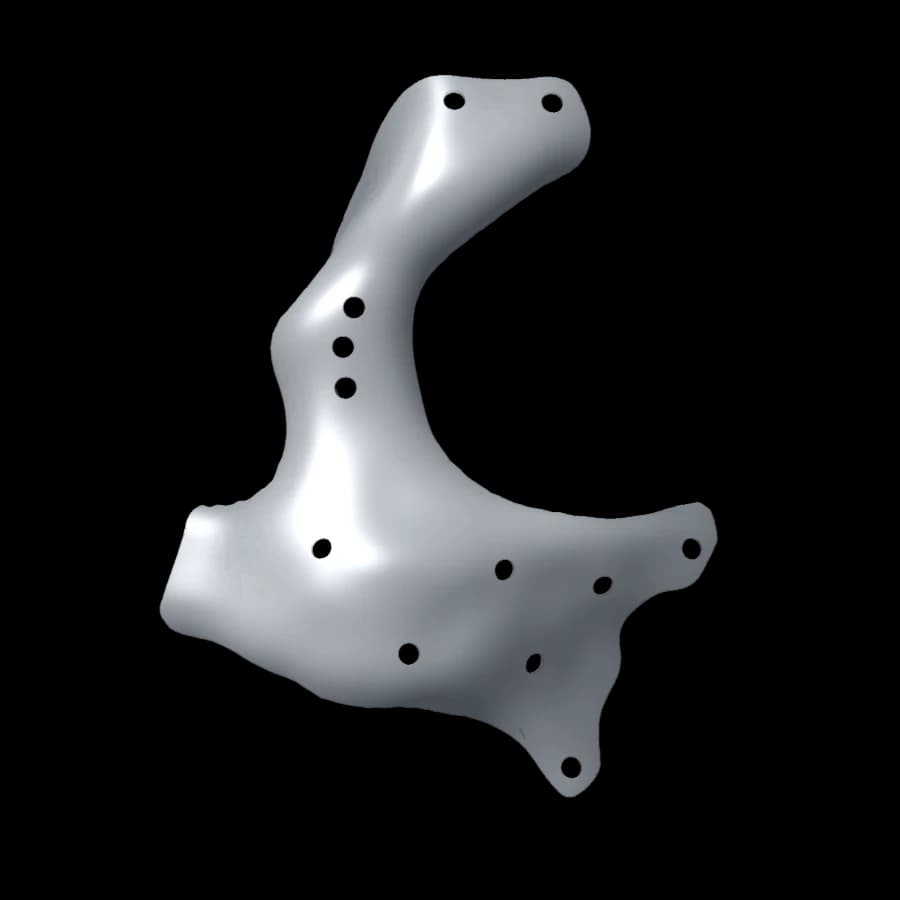 Orbit and zygomaOrbitozygomatic reconstructionFloor, lateral rim and body of the zygoma
- Overall size
- 40 × 38 × 64 mm
- Thickness
- ≈ 0.45 mm
- Volume
- 1.1 cm³
- Mass (Ti-6Al-4V)
- ≈ 5 g
Sources
Documents accessed in October 2026. Amounts are given in the currency and for the year of each source.
- 1Zimmerer RM, Ellis E, Aniceto GS, et al. A prospective multicenter study to compare the precision of posttraumatic internal orbital reconstruction with standard preformed and individualized orbital implants. J Craniomaxillofac Surg. 2016;44(9):1485-1497. doi.org
- 2Pietzka S, Wenzel M, Winter K, et al. Comparison of anatomical preformed titanium implants and patient-specific CAD/CAM implants in the primary reconstruction of isolated orbital fractures: a retrospective study. J Pers Med. 2023;13(5):846. doi.org
- 3Sheta MS, Elsaadany WH. The accuracy of reconstruction of orbital wall fractures using prebent mesh versus patient specific implants: a randomized clinical trial. BMC Oral Health. 2025;25:1719. doi.org
- 4Kotecha S, Ferro A, Harrison P, Fan K. Orbital reconstruction: a systematic review and meta-analysis evaluating the role of patient-specific implants. Oral Maxillofac Surg. 2023;27(2):213-226. doi.org
- 5Burnstine MA. Clinical recommendations for repair of isolated orbital floor fractures: an evidence-based analysis. Ophthalmology. 2002;109(7):1207-1210. doi.org
General information: this article does not replace your surgeon’s advice. Prices vary with the patient, the hospital and the implant; only a formal quote is binding.
A cranioplasty case to review?
Surgeons: send the CT scan for a feasibility study. Patients: your section explains the care pathway.